



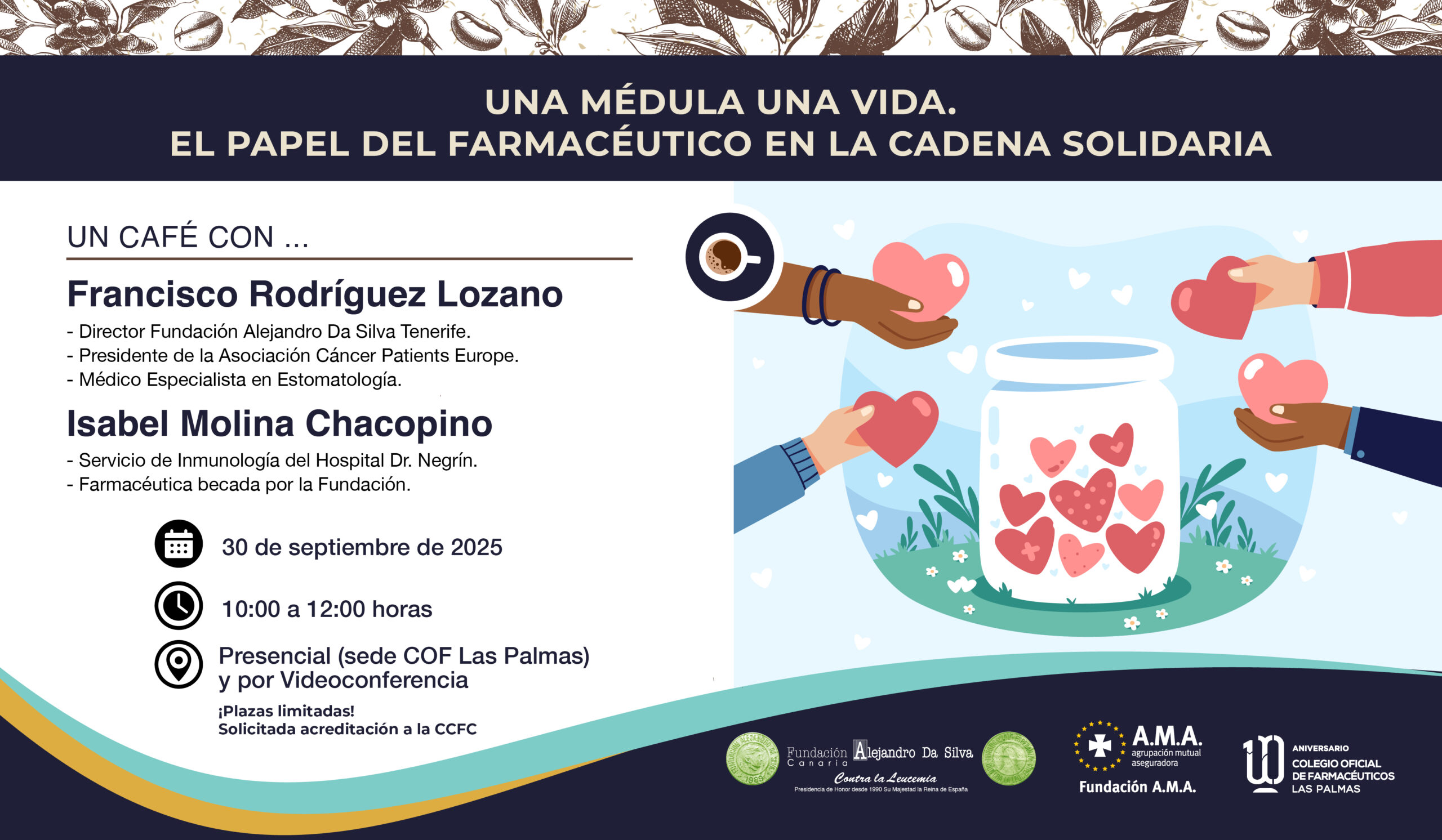
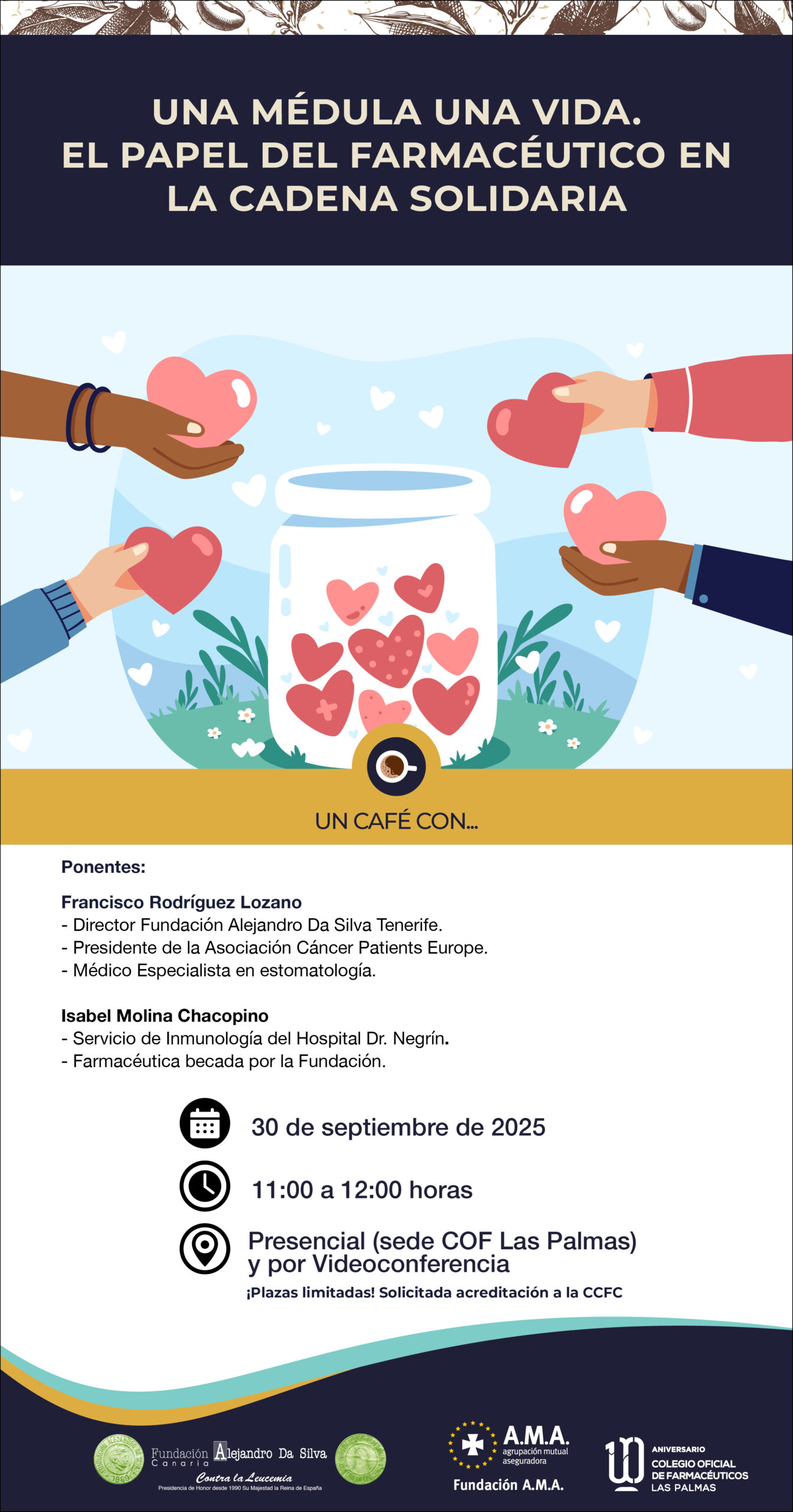
A COFFEE WITH…
ISABEL MOLINA AND FRANCISCO RODRÍGUEZ
ONE BONE MARROW, ONE LIFE. THE PHARMACIST'S ROLE IN THE SOLIDARITY CHAIN.
The next September 30 of 10:00 AM to 12:00 PM, the conference will be held at the Collegiate Headquarters One marrow, one life. The pharmacist's role in the solidarity chain. This training activity aims to highlight the pharmacist's role in promoting bone marrow donation, as well as emphasize the impact of patient associations on public health policies related to cancer. The activity will be led by two specialists who will address the topic from a human, clinical, and outreach perspective.
PFor those who cannot attend in person, the session will be available via videoconference on the Tabaiba virtual campus through GoToMeeting. Advance registration is required. NEW
In-person attendees will be able to enjoy a coffee break at the end of the session, a space to share impressions with the speakers.
 In-person: COF Las Palmas Headquarters In-person: COF Las Palmas HeadquartersVideo conference GoToMeeting |
|
|
|
 Tuesday, September 30
 Number of seats: 40
 Free
Free
The conference will be recorded so that those who cannot attend on the day of the event can watch it later on Virtual Campus Tabaiba of COF Las Palmas, in space «And if you couldn't attend...».
OBJECTIVES
- Raise awareness about the importance of bone marrow donation as a treatment for hematological diseases, especially leukemias.
- Bone marrow transplantation is a medical procedure to replace damaged or diseased bone marrow with healthy bone marrow stem cells. It's commonly used to treat cancers such as leukemia and lymphoma, as well as certain blood disorders and immune deficiencies. The process generally involves several stages: 1. **Pre-transplant Evaluation:** This is a crucial phase where both the recipient and potential donor undergo comprehensive medical tests. For the recipient, it assesses their overall health, the extent of their disease, and their compatibility with a potential donor. For the donor, it evaluates their health status to ensure they can safely undergo the donation process. 2. **Conditioning:** Before the transplant, the recipient undergoes high-dose chemotherapy and/or radiation therapy. This process destroys the diseased bone marrow and suppresses the recipient's immune system to prevent it from rejecting the new stem cells. 3. **Stem Cell Infusion:** The healthy stem cells, collected from the donor (either through bone marrow aspiration or peripheral blood stem cell collection), are infused into the recipient's bloodstream, much like a blood transfusion. These cells travel to the bone marrow and begin to engraft. 4. **Engraftment:** This is the critical period where the transplanted stem cells start producing new, healthy blood cells. It typically takes a few weeks. During this time, the recipient's immune system is severely compromised, making them highly susceptible to infections. They require close monitoring and supportive care, including antibiotics and blood product transfusions. 5. **Post-transplant Monitoring and Recovery:** After successful engraftment, the recipient will continue to be closely monitored for complications, such as graft-versus-host disease (GVHD), where the donor's immune cells attack the recipient's body. Long-term recovery involves gradual immune system rebuilding and potential lifelong management of side effects. **Requirements to be a Bone Marrow Donor:** The requirements to be a bone marrow donor are generally focused on ensuring the safety of both the donor and the recipient. While specific criteria may vary slightly between different bone marrow registries (like Be The Match in the United States), common requirements include: * **Age:** Typically between 18 and 60 years old. Some registries may extend the upper age limit in certain circumstances. * **General Health:** Donors must be in good general health, without significant chronic illnesses that could pose a risk during donation or affect the quality of the donated stem cells. This includes conditions like: * Heart disease * Lung disease * Kidney disease * Liver disease * Certain autoimmune diseases * Active cancer or a history of certain cancers. * **Weight:** A minimum weight is usually required, often around 110 pounds (approximately 50 kg), to ensure enough blood volume for the collection process. * **Absence of Infectious Diseases:** Donors must not have certain infectious diseases, such as HIV, hepatitis B, or hepatitis C, as these could be transmitted to the recipient. * **No History of Certain Conditions:** Donors should not have a history of: * Drug abuse * Certain psychiatric conditions that might affect their ability to consent or cope with the process. * Receiving certain types of therapy or medical treatments that could interfere with donation. * **Commitment:** Donors must understand and be willing to commit to the entire donation process, which can involve several doctor visits, tests, and potentially the donation itself, which can take several hours. They must also be aware of the potential risks, though generally low. * **Compatibility:** The most crucial requirement for a *specific* transplant is that the donor's human leukocyte antigens (HLA) profile closely matches the recipient's. HLA typing is done through a simple blood test. **How to Become a Donor:** Individuals interested in becoming a bone marrow donor can join a bone marrow registry. The process usually involves: 1. **Online Registration:** Completing an application online or at a recruitment event. 2. **Health Questionnaire:** Answering questions about your medical history. 3. **Swab Kit:** Receiving a cheek swab kit by mail (or sometimes a blood sample is taken at a registry drive). You'll swab your cheeks and return the kit to the registry to have your HLA type determined. 4. **Joining the Registry:** If you meet the initial criteria, your HLA type is added to the registry, making you available to be matched with a patient in need. If you are a match for someone, the registry will contact you for further testing and to discuss the donation process in detail.
- Disseminate the role of patient associations in advocating for supportive health policies.
- Highlight the pharmacist's role as a key agent in donor outreach and recruitment.
- Present effective donor acquisition campaigns and real-life experiences that inspire civic engagement.
PROGRAM
Introduction
Francisco Rodriguez Lozano Director of the Alejandro Da Silva Canary Foundation in Tenerife and President of Cancer Patients Europe. Specialist in Stomatology and cancer survivor.
- The role of patient advocacy groups in cancer control policies.
- Promotion of bone marrow donation as a therapeutic tool.
Content
Isabel Molina Chacopino Pharmaceutical researcher funded by the Alejandro Da Silva Canary Foundation. Immunology Service of Dr. Negrín Hospital.
- What is a bone marrow transplant?
- What does it mean to be a bone marrow donor (BMD)?
- Who can become a DMO?
- Donor acquisition campaigns: strategies and results.
- The role of the pharmacist in raising awareness and recruiting for DMO.
REGISTRATION
EThe registration deadline is September 28, 2025.
The capacity will be limited to 40 attendees, so it isReservations are essential.
This activity is accredited by the Canary Commission for Continuing Training of Health Professions, it being necessary to attend the total of the individual session and a minimum of two sessions in the year to obtain accreditation.
- Due to limited space, cancellations must be communicated in writing to the email desarrollopro@coflaspalmas.es with at least 5 days' notice before the start of the course to be eligible for a refund.
- The scheduled training courses have a minimum and maximum number of places. If the planned minimum is not reached, the College reserves the right to suspend them.
For more details, please see the General training conditions of COF Las Palmas.
COF Las Palmas Auditorium
Official College of Pharmacists of Las Palmas, Alejandro Da Silva Canary Foundation