




Two years before the Canary Islands were divided into two provinces, pharmacists from Gran Canaria, Lanzarote, and Fuerteventura went their separate ways from their colleagues on the western islands of the Archipelago. It was not an easy path, as there was considerable pressure on the State Administration.
Nevertheless, the efforts of a significant part of the group and the support of various politicians and Gran Canarian society, through Federico León y García, the mayor of Las Palmas de Gran Canaria, managed to obtain the Grant Order that allowed the creation of a new professional college.
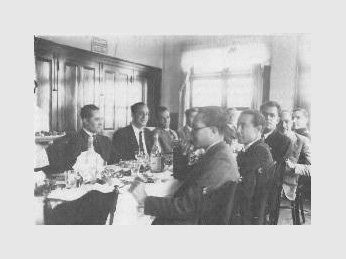
Thus, on December 29, 1925, 24 pharmacists met in a pharmacy on Alameda de Colón, owned by Bartolomé Apolinario. This would be the first General Assembly of the Official College of Pharmacists of Las Palmas and, therefore, the moment of its foundation.
In that meeting, the members of the first Governing Board were elected. Bartolomé Apolinario was elected President, Juan Mañas became secretary, Gaspar Meléndez was appointed treasurer, and Federico León was appointed accountant, while Juan Puig, Agustín Olózaga, and Manuel Blanco were designated as members.
The first woman joined the College one year after its founding, María del Pino Suárez López, who requested permission to dispense medication in Telde.
In 1930, the number of registered members was 37, and the fee was 15 pesetas.
In these hundred years, the pharmacist's commitment to island society has been unwavering, adapting to the healthcare needs of each moment, providing solutions, and playing an active role in improving patient care.

The presidency fell to Bartolomé Apolinario, Juan Mañas became secretary, Gaspar Meléndez was appointed treasurer, and Federico León accountant, while Juan Puig, Agustín Olózaga, and Manuel Blanco were designated members. However, as soon as these results were read, the accountant stood up and blurted out that he would “in no way” accept the position, and the secretary also refused because “personal matters” prevented him from doing so.
Up to four members resigned at that time, creating a situation that was difficult to salvage, so “having doubts as to whether the Board was constituted or not due to these resignations” The session was adjourned, and the delegate of the King's Government was notified so that he could resolve the matter. Fortunately, he declared the College constituted and, in accordance with current legislation, the excuses of those who claimed impossibility to exercise their office were dismissed.
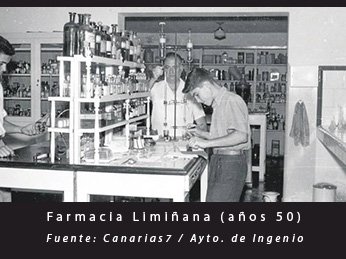
With this first hurdle cleared, the College's priority was to draft internal regulations that would allow it to begin functioning. The regulations from Seville, Madrid, Barcelona, and Tenerife were used as a reference. It was “hard work, taking a few nights, four or five, and working until dawn,” Bartolomé Apolinario wrote.
Among the regulations of this bylaws, it stood out that; unexcused absences from the General Meeting were punishable by fines ranging from five to twenty-five pesetas, which had to be paid even by the president.
These internal issues did not slow down the College's external activities, which did not have it easy when it began to deal with pricing policy, the sector's main problem. Some pharmacies altered retail prices, which divided pharmacists and soured the atmosphere to the point where the Governing Board attempted to resign on several other occasions.
Nevertheless, the heated debates that arose on this topic and the regulation of night, holiday, and Sunday shifts, as well as opening and closing hours, were quickly resolved with the creation of the Statute, which later served as a model for the development of those of other colleges.
The Deputy Delegate of Pharmacy of the Ministry of Health controlled pharmacies, herbalists, drugstores, spice shops, medicines, and poisons, but their duties were gradually taken over by the College until their role disappeared in 1933.
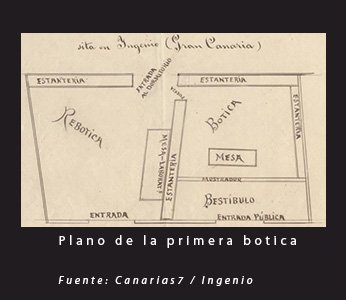
One year after its establishment, the first female pharmacist in Las Palmas, María del Pino Suárez López, was registered. She requested permission to dispense medications in Telde. After 5 years, the number of registered members was 37, the fee was 15 pesetas, and it took 8 years to acquire the first copying machine.
The first president held office for five months and returned after five other presidents, until in 1936 he was succeeded by Vicente López Socas, who led the collective for a quarter of a century.

The College currently has 1200 registered members., The photocopier gave way to the then unimaginable Electronic Prescription, and the 19,300 pesetas budget from 1935 has been converted with great effort into 1.5 million euros and the secret ballot into a raised hand vote.
Circumstances, the economy, mindsets, and society as a whole have radically changed, but the spirit of defending common interests remains intact.
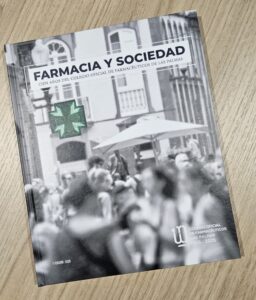
One hundred years of the College of Pharmacists of Las Palmas. (Click image to download publication)
Pharmacy and Society
100 Years of the College of Pharmacists of Las Palmas
https://www.coflaspalmas.es/
Edited by Juan José Laforet
Texts
José Antonio Apolinario Cambreleng. Pharmacist
Juan José Laforet. Official Chronicler of Gran Canaria
Chronicles of the Canary Islands Magazine no.11 (2015)
Farmacia La Vieja Website https://farmacialavieja.com
The Voice of Lanzarote. The three centennial pharmacies of Arrecife
Photography
COFLP File
Yiyo Espino
Francisco Artiles Collection
Mejías Pombo Family Archive
FEDAC