

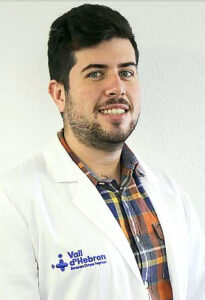
 Héctor Carlos García Díaz is a student from Gran Canaria who is completing his fourth-year residency in Hospital Pharmacy at Vall d'Hebron Hospital in Barcelona. He studied for his Pharmacy degree at Complutense University of Madrid. It was there that he began to develop an interest in oncology and research. Subsequently, he completed a Master's degree in Biomedical Research specializing in cancer at the University of Barcelona, where he worked on a project involving the generation of CAR-T cells for the treatment of tumors at the Clínic Hospital in Barcelona. There, he decided he wouldn't be content with just research, but wanted to be part of clinical teams and contribute knowledge in pharmacotherapy to clinical decisions. To achieve this, he prepared for the FIR exam and chose Vall d’Hebron to complete his Hospital Pharmacy residency, considering it one of the most important in Europe for oncology. During his residency, he focused his training on oncology, both in research projects and by completing a specialized Master's degree in Pharmaceutical Oncology from the University of Valencia. Currently, he is undertaking a rotation in Leukemia at the MD Anderson Cancer Center in Houston, Texas. Professionally, he describes himself as a young man «with a lot of initiative, passionate, educational, and restless.».
Is your work a job or a calling?
– Vocation. Since university, I've felt a passion for pharmacotherapy. I really enjoy studying and applying knowledge to improve patients' quality of life. It's very gratifying when patients in hospitalization thank you for your care.
What is the job of a hospital pharmacist like?
The first thing to make clear is that the function of a hospital pharmacist is not research. We can do it, but it's optional since we have a patient care role like medical or nursing staff. Hospital Pharmacy is a four-year specialty with numerous rotations that can be grouped into three: management/logistics, technical, and clinical. What attracts me is the clinical aspect - we do at least 1 year - and being able to work with the medical team modifying patient prescriptions for better drug use. In Spain, all FIR (Pharmaceutical Resident Intern) are hospital pharmacists; there isn't a subspecialty as such in oncology since the four years include training in numerous areas. However, you can build your resume in areas that attract you, and that can help you get hired in that specific area.
– What is attractive about that, as defined by you, subspecialty?
Specifically, I like the oncohematology field because it has a significant impact on society, there's a lot to study, and new things are always emerging. It's wonderful to see how some treatments have been able to cure or improve the prognosis of patients who, just a few decades ago, would have died quickly.
Is the role of the pharmaceutical professional in this matter the same in all countries?
The role of the oncology pharmacist in Spain is to ensure the acquisition, custody, prescription validation, pharmaceutical care, supervision of preparation/dispensing, and to ensure correct administration. Specifically, when we validate the medical prescription, we must ensure that it is indicated for that patient, review their clinical history - background, age/weight, current condition, concomitant treatments, etc. - and laboratory results - kidney and liver function, etc. - to make sure the patient can receive the treatment. On many occasions, we contact the medical team due to drug interactions or the need to adjust chemotherapy doses. This is of vital importance since these treatments have a narrow therapeutic margin, and even a minimal excess results in adverse effects, and conversely, if insufficient amounts are given, it can compromise the effectiveness of the tumor treatment. In the United States, the oncology clinical pharmacist leaves logistical/technical tasks to pharmacists. operational who do not have the specialization. This way, it allows the clinical pharmacist to be with the medical and nursing team and make rounds with them. In the United States, the pharmacist is the one who prescribes on behalf of the doctor if the doctor needs to confirm it. Only in the case of chemotherapy or targeted cancer treatments is a second signature from the doctor needed to confirm the treatment prescribed by the pharmacist. This is completely the opposite of Spain, where the doctor prescribes and the pharmacist validates. This allows the pharmacist the freedom to act more freely regarding patient treatment. This freedom is greater with non-antineoplastic drugs.
 Will we see something like this in the Canary Islands?
I don't know how things are done in the Canary Islands firsthand, but it is said that there's a quite clinical profile. Since we have a public system, it will never reach the level of private companies in the United States. However, if we optimize our human and technological resources and manage to be more efficient in the system, pharmacists could play the role we play in the United States. For example, by delegating technical/administrative work and focusing on clinical tasks.
- Tell me how you see the future in this field.
The future of healthcare in Spain, in my opinion, will be heavily focused on hospitalization at home, digital platform communication, and above all, educating proactive patients who understand their illness, are well-informed, and can participate in treatment decision-making. On the other hand, within the profession itself, the pharmacoeconomic evaluation of medications is very important. As new therapies, increasingly expensive ones, come onto the market, we must ensure the sustainability of our system by funding those medications that truly provide a benefit to patients in relation to their cost.
– With Artificial Intelligence seemingly encompassing everything, how will it develop in the pharmaceutical world?
-Well, AI certainly has a place in our profession. We cross-reference information from medical histories with analytical data and drug characteristics, allowing us to make pharmaceutical interventions to optimize drug treatment. Or, for example, when creating Standard Operating Procedures (SOPs) for sterile or non-sterile preparations, we search for information in different databases to develop a document that enables the technician to prepare a medication and the pharmacist to perform quality control. An AI can do all of this using algorithms that cross-reference information and give you an answer. I believe it's an opportunity to be efficient in our processes and dedicate more time to providing quality and more human pharmaceutical care, something a machine can never provide. This is applicable at both the hospital and primary care levels.